No part of this post is written with explicit intent to compare the literal and figurative, and any resemblance to any character that died in 1976 may be purely coincidental.
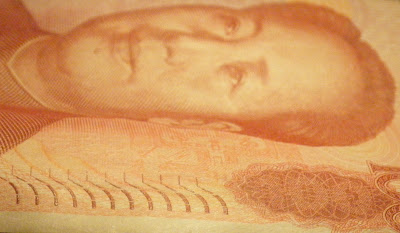
Introducing the Chinese ¥100 bill -two of them, to be exact:
 detect the twin: indubitable identical and fraternal fake
Let me explain.
Over the last month of 2009, I came to be the unwitting owner of two fake ¥100 banknotes.
Interestingly, I could only have received them from a student of mine, and it implies either their knowing of the counterfeit bills, or that they two were unaware of their being counterfeit.
rejection
I was made aware of their fakehood by several vendors: the taxi driver, the grocery store clerk, the phone card street vendor. Nobody wanted my pink bills.
Was it simply because of the small tear, running vertically? The torn off corner? Was this simply the coal left for me at the end of a lackluster year?
eagle eye
It seems the answer is not so straightforward. Upon a closer look, the differences are neither minute nor few.
Challenge: if you scan the photos but do not skim the following text, can you spot the fake?
Using my neighborhood as a natural light-table, here is a comparison of two bills. First, with flash, then without:
 see any differences?
 how about now?
 watermark or wash out?
Looking closer still, in plain sight, the fake (right) offers a 'watermark' that is no more than a fleshy ink (note, the real watermark (left) can be seen even from looking at your computer screen from a different angle):
 ghostly or yellowed?
The close-up below addresses two aspects: the iridescence of the '100' at left (real), and the luster-lacking design at left (fake):
 iridescent does it... and does it not
Another method, impossible to convey virtually, is the textured surface of certain areas of the note. Mao's left hairline is subtly raised, as is the '1oo' and emblem below, as well as the curved ridge of lines extending below (the latter being present in recent printings). The fake, at right, offers some, but not all of this rich texture. You'll have to trust me on this.
Holding the note at edge and looking left across the top right, you will find that a perpendicular look at the oval 'emblem' of a fake note offers nothing more. The real ¥100 note, however, has a a '100' hiding inside:
 how many '1oo' can you see?
In the below image, the real note is at left, the fake at right. There are obvious differences in the pattern clarity and color subtlety. Generally speaking, the fake is never as delicate; in fact, it is often rather bold:
Holding the note at edge and looking left across the top right, you will find that a perpendicular look at the oval 'emblem' of a fake note offers nothing more. The real ¥100 note, however, has a a '100' hiding inside:
 how many '1oo' can you see?
In the below image, the real note is at left, the fake at right. There are obvious differences in the pattern clarity and color subtlety. Generally speaking, the fake is never as delicate; in fact, it is often rather bold:
 textured lines: all in the touch
The difference is that the magnetic strip at top (fake) is merely a painted green line, whereas the real magnetic strip actually shows depth in color against the neighboring ink:
 magnetic strip or painted line?
The offset of the magnetic strips is no alarm, unfortunately; not all magnetic strips are equally spaced along the horizontal.
flipside
Looking at the back side of the ¥100 note, more differences await:
 ZHONGGUO RENMIN YINHANG: People's Bank of China
The color differences in the pattern below would only raise concern if comparing side by side, and even then, this alone cannot discern the counterfeit bill:
 color differences
Below, design subtlety shows through on the fake (top) and real (below) bills, as do color intensity (note the swirled crests within the double zeroes). Additionally, the blue and red mosaic tiles are truncated at the bottom left:
 missing mosaic...
This below image makes it difficult to see any difference, but it is possible to tell that the '100' bleeds through from the front, legible still:
 barely visible... but there!
Note the differences in design below: the fake (top) has a more unified color hue than the real bill (below). Also, the fake leaves little guesswork in deciphering the repeated 'RMB100' lettering, as compared with the subtlety below it:
 under scrutiny: the stark and subtle
Looking at the iridescent magnetic strip, other detail differences appear.
Some results using flash:
 Fake is dull. Real is iridescent.
Without the presence of flash, another detail comes to light:
 Fake has inversed '¥100'. Real is iridescent, but without clarity of text.
lessons learned
A few words of warning:
Beware the crisp bill that speaks stiffly of unsophisticated paper brittle, not the minted cloth robust.dead giveaways
Beware the clean tear on a new bill, not yet worn with the use of trusted years.
Spend a few minutes getting to know your money, issued straight from the bank.
When in doubt, compare with a trusty bill in your pocket.
And lastly, trust in people, but never in money.
Mao might be dead, but these counterfeits are being given away like spittle to the wind.
My days of blindly accepting payment from a trusty source, however, are over. I will pass a shrewd eye over any bill, be it received in straightforward friendship or slippery foeship.
As for the fate of the two counterfeit bills in my possession?
Lucky for me, I discovered my fakes before the bank would've, as the notes would have been confiscated. And so, they will become a memorable part of a scrapbook from my time in China, the land of real fakes.
Note: Access to Blogger is still blocked within China. Without access to a much appreciated VPN (proxy), I would be unable to publish to my blog from within mainland China. Thus, I am blessed and grateful to be sharing. With every post, I hereby protest the oppressive nature of the Chinese government blocking access to any part of the web.


